Coeliac Disease, Fertility and Pregnancy
If you’re planning a family, coeliac disease is a fair thing to have on your mind — and the headline is a reassuring one. Undiagnosed or untreated coeliac disease is associated with difficulty conceiving and with some pregnancy complications, but the evidence also shows that once it’s diagnosed and well managed on a gluten-free diet, outcomes generally move much closer to those of everyone else. In other words, this is a reason to get it diagnosed and controlled, not a reason to worry.
Below is a calm walk through what the research suggests at each stage — trying to conceive, pregnancy itself, and the practical side of managing the diet — and who to talk to along the way.
The short answer
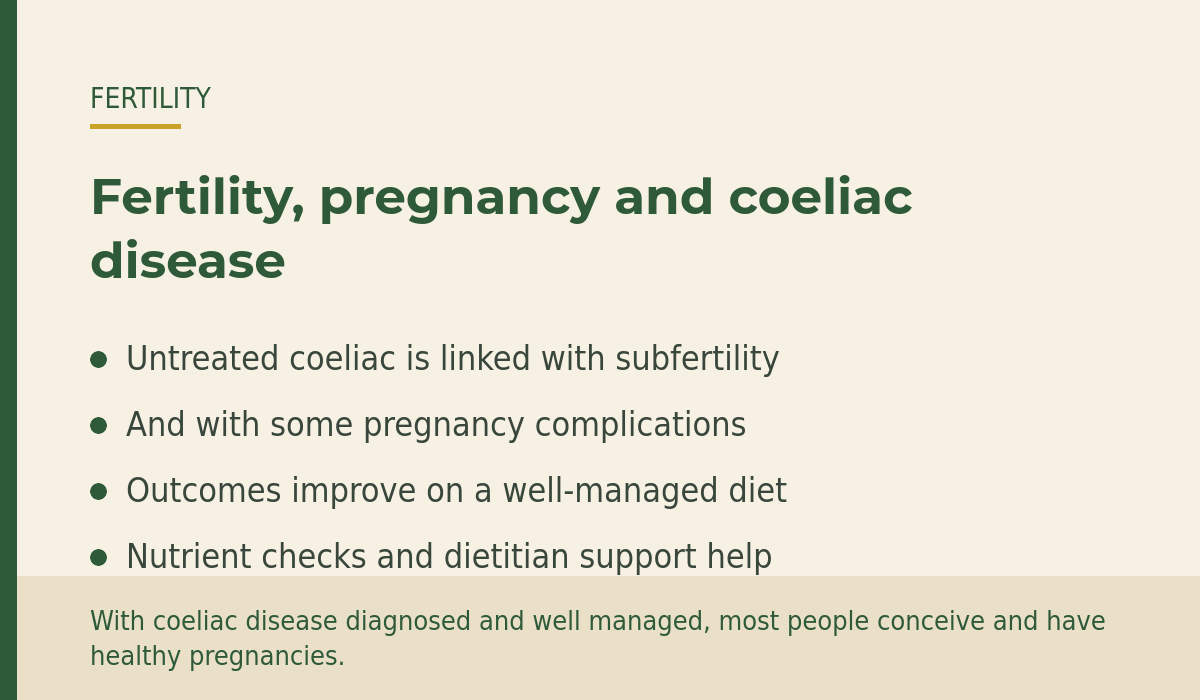
Untreated coeliac disease is linked with subfertility and with complications such as low birth weight and preterm birth. The reassuring part is that a well-managed gluten-free diet is associated with outcomes close to the general population — so most people with coeliac disease go on to conceive and have healthy pregnancies. If you’re planning a pregnancy or finding it hard to conceive, it’s worth making sure coeliac disease is diagnosed and well controlled, with your GP, obstetric team and a dietitian.
The link between coeliac disease and fertility
Undiagnosed coeliac disease has been associated with subfertility — taking longer to conceive — and it’s sometimes picked up during fertility investigations when no other cause is found. The likely reasons overlap with the rest of the condition: shortfalls in nutrients such as iron, folate, zinc and B12, the effects of ongoing inflammation, and, in some women, changes to the menstrual cycle. These are associations rather than certainties, and plenty of people with coeliac disease conceive without any difficulty at all.
The practical takeaway is a hopeful one: because these factors improve as the gut heals and nutrient levels recover on a gluten-free diet, getting coeliac disease diagnosed and well managed is one of the constructive things within your control.
If you’re finding it hard to conceive
If you already have coeliac disease, staying strict with the gluten-free diet and keeping up with your follow-up checks is the best foundation. If you don’t have a diagnosis but coeliac disease runs in your family or you have symptoms, it’s reasonable to ask your GP about testing as part of the picture — occasionally, unexplained difficulty conceiving is the prompt that leads to a coeliac diagnosis.
One important practical point: the blood tests and biopsy used to diagnose coeliac disease only work reliably while you’re still eating gluten. So if testing is on the cards, don’t remove gluten first — talk to your GP before making any changes, so the results are accurate.
Pregnancy
Undiagnosed or untreated coeliac disease has been associated with pregnancy complications including low birth weight, preterm birth and, in some studies, a higher risk of miscarriage. It’s understandable if reading that feels unsettling — so it’s worth holding onto the other half of the finding: a well-managed gluten-free diet is linked with outcomes much closer to those of the general population. The diet you’re already following is doing a lot of the work here.
With coeliac disease diagnosed and well controlled, most people have healthy, uncomplicated pregnancies. The sensible steps are the ordinary ones done a little more attentively — which the next section covers.
Planning and managing a pregnancy with coeliac disease
- Keep the diet strict. A well-controlled gluten-free diet before and during pregnancy is the single most helpful thing, letting the gut absorb nutrients well for you and your baby.
- Take folic acid. Folic acid before conception and in early pregnancy is recommended for everyone; ask your GP whether your history means a higher dose is advised for you.
- Check your nutrient levels. Your team may check iron, folate, B12 and vitamin D, since these matter in pregnancy and can run low in coeliac disease. Supplements are guided by your clinician.
- Involve a coeliac-aware dietitian. They can help you eat well and confidently through pregnancy, including a naturally nutrient-rich gluten-free diet.
- Tell your antenatal team. Letting your midwife and obstetric team know you have coeliac disease means your care is joined up.
What about men’s fertility?
Most of the research looks at women, but some studies have reported associations between untreated coeliac disease and reduced fertility in men too. The evidence here is more limited and less certain, so it’s best treated as a “worth knowing” rather than a firm conclusion. As with everything else, the same logic applies: if coeliac disease is present, getting it diagnosed and well managed is the sensible course, and it’s a conversation to have with a GP.
After the birth
You can continue your gluten-free diet as usual, including while breastfeeding, keeping an eye on nutrient levels with your team. Questions about when and how to introduce gluten to your baby, and any testing where there’s a family history, are best discussed with your GP or a paediatric dietitian, who can tailor advice to your family.
At a glance
A quick summary — reassuring, and always tailored to you by your medical team.
| Stage | What the evidence suggests | What helps |
|---|---|---|
| Trying to conceive | Untreated coeliac is associated with subfertility; it’s sometimes found during fertility checks | Diagnosis and a well-managed diet; test before removing gluten; ask your GP |
| During pregnancy | Untreated coeliac is linked with low birth weight and preterm birth; a managed diet brings outcomes close to average | Strict gluten-free diet, folic acid, nutrient checks, an informed antenatal team |
| Managing the diet | Good absorption of iron, folate, B12 and vitamin D matters for you and your baby | A coeliac-aware dietitian; supplements as your clinician advises |
Who to talk to
If you’re planning a pregnancy, having difficulty conceiving, or already expecting, bring coeliac disease into the conversation with your GP and, once pregnant, your midwife and obstetric team. A coeliac-aware dietitian rounds out the support. None of this is cause for alarm — it’s simply making sure the people looking after you have the full picture, so your care is joined up and reassuring.
The bottom line
- Untreated coeliac disease is associated with subfertility and some pregnancy complications — associations, not certainties.
- The reassuring evidence: a well-managed gluten-free diet is linked with outcomes close to the general population.
- Most people with coeliac disease conceive and have healthy pregnancies; getting diagnosed and controlled is the constructive step.
- If testing for coeliac disease is possible, don’t cut out gluten first — and loop in your GP, obstetric team and a dietitian.
Keep exploring
- Coeliac Disease Beyond the Gut — the whole-body picture this page is part of.
- Coeliac Disease, the Brain and Nerves — the neurological associations, calmly explained.
- Coeliac Disease and Mental Health — anxiety, depression and support.
- Coeliac Follow-Up Care — the reviews and nutrient checks that keep you well.
- Coeliac Diagnosis & Medical FAQ — the questions people ask around testing, including testing before removing gluten.
Frequently asked questions
Can coeliac disease affect fertility?
Undiagnosed or untreated coeliac disease is associated with subfertility, likely through factors such as nutrient deficiencies and inflammation. It’s an association rather than a certainty, and it often improves once coeliac disease is diagnosed and managed on a gluten-free diet. Many people with coeliac disease conceive without any difficulty.
Can I have a healthy pregnancy with coeliac disease?
Yes. With coeliac disease diagnosed and well managed on a gluten-free diet, outcomes are generally close to those of the general population, and most people have healthy, uncomplicated pregnancies. Working with your GP, midwife, obstetric team and a coeliac-aware dietitian keeps your care joined up.
Do I need extra supplements in pregnancy?
Folic acid before conception and in early pregnancy is recommended for everyone, and your GP can advise whether your history means a higher dose. Your team may also check iron, folate, B12 and vitamin D, since these matter in pregnancy and can run low in coeliac disease. Take supplements as your clinician advises.
Does coeliac disease affect men’s fertility?
Some studies report an association between untreated coeliac disease and reduced fertility in men, though the evidence is more limited and less certain than for women. As elsewhere, the sensible course is to get coeliac disease diagnosed and well managed, and to discuss any concerns with a GP.
This page is general information, not medical advice. The links described here are associations rather than certainties — discuss your own situation, including any plans for pregnancy, with your GP, obstetric team or a coeliac-aware dietitian.
Sources & standards: Coeliac UK (fertility, pregnancy and coeliac disease; the gluten-free diet); NICE guideline NG20 (coeliac disease: recognition, assessment and management); the British Society of Gastroenterology (BSG) guidelines on the diagnosis and management of adult coeliac disease; the Codex Alimentarius gluten-free standard of no more than 20 ppm (20 mg/kg) of gluten; and AOECS (Association of European Coeliac Societies). Last verified: 2026-07-21.
Reviewed against the HTGF methodology — every claim sourced, every listing tiered and dated. This article is practical guidance, not medical advice.
Gluten-free confidence in your inbox.
Practical tips, new guides and community stories. No spam. Unsubscribe anytime.