Coeliac Disease and Mental Health: Anxiety, Depression and Support
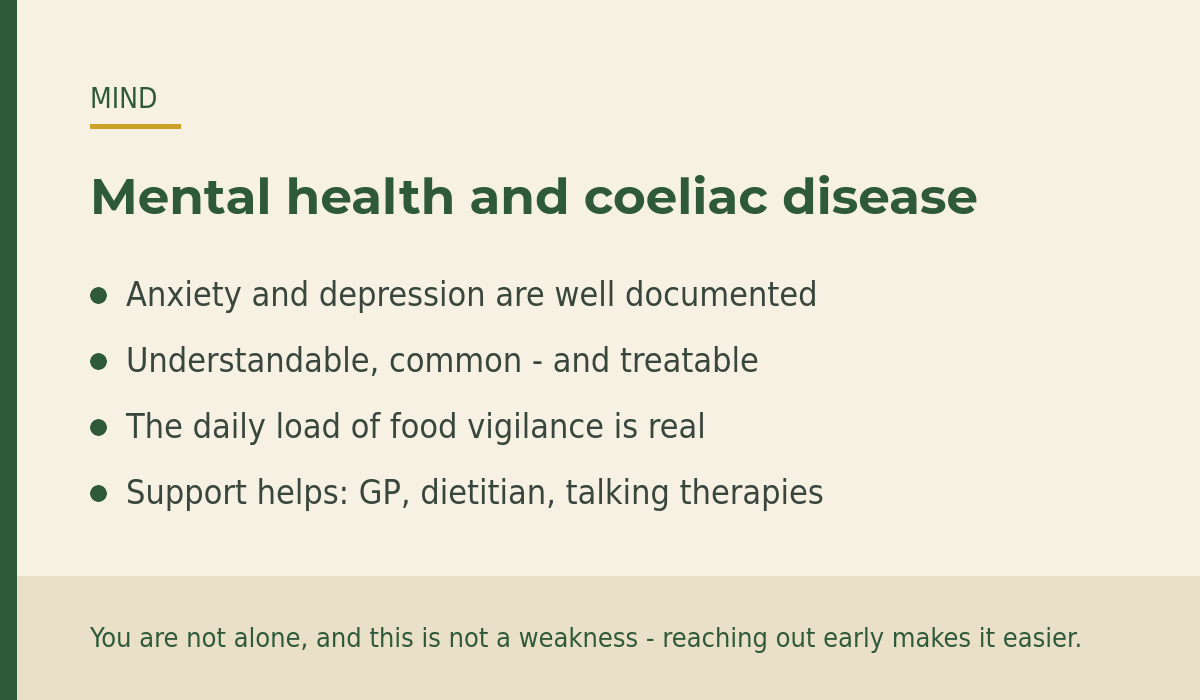
Living with a condition that touches every meal, every menu and every social occasion is genuinely demanding — and it’s completely understandable if it weighs on you. Higher rates of anxiety and depression are well documented among people with coeliac disease, and naming that clearly matters: it isn’t a weakness, a character flaw or something to push through alone. It’s common, it’s understandable, and it responds to support.
This page is here to take some of the weight off — to explain why the link exists, to talk gently about the harder parts, and to point you toward people who can help. If food has started to feel stressful or isolating, you’re in good company, and there are practical, kind ways through it.
The short answer
Anxiety and depression are more common in people with coeliac disease than in the general population — partly because of the daily mental load of managing the diet, and partly because of factors like nutrient deficiencies that can affect mood. It’s common and treatable. A GP, a coeliac-aware dietitian and, where helpful, talking therapy can all make a real difference. If you’re struggling, please reach out — you don’t have to carry it alone.
Why coeliac disease and mental health are connected
There are two threads, and they often twist together. The first is simply the load of living with it: the constant label-reading, the vigilance when eating out, the awkward conversations, the worry about accidental gluten, and the sense of missing out at meals that are meant to be relaxed. That’s a lot to hold, day after day, and it would wear on anyone.
The second thread is more biological. Undiagnosed or newly diagnosed coeliac disease can leave you low in nutrients — iron, vitamin B12, folate and vitamin D among them — that play a part in how we feel, and there’s growing interest in the gut–brain relationship more broadly. The exact contribution of each factor is still being studied, so it’s fairest to say the mood link is real and multi-layered rather than down to any single cause. The encouraging side of that is there are several places to intervene.
Anxiety
Anxiety often clusters around food and the situations food creates: a restaurant that can’t answer your questions, a work lunch, a holiday, a family gathering where you’re not sure what you can eat. Some hypervigilance is understandable — it’s how you protect yourself — but when the worry starts to shrink your world, or follows you long after the meal, it’s worth some support rather than more willpower.
If that resonates, our companion piece on coeliac anxiety and the stress around food walks through it gently and practically. The aim isn’t to lower your guard on the diet — it’s to carry it more lightly, so mealtimes feel less like a test.
Depression and low mood
Studies consistently report higher rates of depression among people with coeliac disease. That can look like persistent low mood, loss of interest in things you used to enjoy, tiredness, or a flatness that’s hard to shake. None of it means you’re coping badly — it’s a recognised part of the picture for a lot of people, and, importantly, it’s treatable. The same routes that help anyone with low mood are open to you, and correcting any nutrient shortfalls is a sensible part of the mix.
When eating starts to feel complicated
Coeliac disease asks you to be careful with food for the rest of your life, and for most people that vigilance sits alongside a normal, relaxed relationship with eating. Sometimes, though, careful can tip into fraught — when food feels like a source of fear more than nourishment, when the list of things you’ll eat keeps narrowing beyond what the diet requires, or when meals bring more anxiety than they should. That’s not a judgement or a diagnosis; it’s simply a sign that the balance has shifted and some gentle support would help.
If any of that feels close to home, you deserve kindness rather than pressure. A GP and a coeliac-aware dietitian can help you keep the diet strictly where it needs to be while easing the fear around it, and can involve further support if that would help. Reaching out early tends to make things easier, not harder.
What tends to help
- Talk to your GP. They can check for treatable causes such as low iron or B12, and open the door to talking therapies or other support where that fits.
- See a coeliac-aware dietitian. Confidence with the diet lowers the background anxiety, and closing nutritional gaps supports mood as well as the gut.
- Lean on community. Talking to other people who genuinely get it — through a coeliac charity or a moderated group — can lift the isolation quickly.
- Give the diet time to work. Many people notice mood and energy improve over the first months on a gluten-free diet as the gut heals and levels recover, though it isn’t a substitute for mental-health support when that’s needed.
- Be patient with yourself. Adjusting to a lifelong condition is a process, not a switch you flip. Small, kind steps count.
At a glance
A gentle guide, not a checklist to grade yourself against — and never a substitute for talking to someone.
| If you’re feeling… | It might show up as… | Something that can help |
|---|---|---|
| Anxious around food | Dreading eating out, avoiding social meals, constant worry about cross-contact | A repeatable eating-out routine, dietitian support, talking therapy; our anxiety guide |
| Low or flat | Persistent low mood, tiredness, losing interest in things you enjoyed | A GP conversation, checking iron and B12, talking therapies |
| Isolated | Feeling left out at meals, like no one quite understands | Coeliac community and support groups; sharing it with people close to you |
| Overwhelmed by food rules | Food feeling fraught, your list of “OK” foods narrowing beyond what the diet needs | Gentle, early support from your GP and a coeliac-aware dietitian |
Please reach out
If you’re struggling with your mental health, please talk to someone — your GP is a good first step, and you can also reach a mental-health support line in your country at any time. In the UK and Ireland, for example, the Samaritans are there day or night on 116 123, and you can call NHS 111 for urgent help. You don’t need to wait until things feel unbearable, and you don’t have to manage it alone.
The bottom line
- Higher rates of anxiety and depression are well documented in coeliac disease — it’s common, understandable, and not a weakness.
- The link comes partly from the daily mental load of the diet and partly from factors such as nutrient deficiencies that affect mood.
- It’s treatable: a GP, a coeliac-aware dietitian, community and talking therapies all help, and the diet itself often lifts mood as the gut heals.
- If you’re struggling, please reach out — to your GP or a mental-health support line. You’re not alone.
Keep exploring
- Coeliac Anxiety and the Stress Around Food — when food feels stressful or isolating, and what helps.
- Coeliac Disease Beyond the Gut — the whole-body picture this page is part of.
- Coeliac Disease, the Brain and Nerves — brain fog, and the neurological associations.
- Coeliac Disease, Fertility and Pregnancy — supportive, evidence-based reassurance.
- Your First 90 Days With Coeliac Disease — a gentle roadmap for settling in.
Frequently asked questions
Is it normal to feel anxious or low after a coeliac diagnosis?
Very much so. Adjusting to a lifelong condition that affects every meal is a big change, and higher rates of anxiety and depression are well documented in coeliac disease. It’s common and understandable rather than a sign you’re coping badly — and it’s treatable, so it’s worth talking to your GP.
Can a gluten-free diet improve my mood?
Many people find their mood and energy improve over the first months on a gluten-free diet, as the gut heals and nutrient levels such as iron and B12 recover. It varies from person to person, and the diet isn’t a substitute for mental-health support when that’s needed — think of it as one helpful part of the picture.
Who can I talk to if food feels overwhelming?
Your GP is a good starting point, and a coeliac-aware dietitian can help you keep the diet strict while easing the anxiety around it. Coeliac community groups can lift the isolation too. If food has started to feel fraught or your relationship with eating is causing distress, gentle, early support helps.
When should I seek help?
If low mood or anxiety persists, affects your daily life, or is changing your relationship with food, please reach out — you don’t need to wait until it feels unbearable. Your GP or a mental-health support line in your country can help, and you don’t have to manage it alone.
This page is general information and support, not medical advice, and it isn’t a substitute for professional mental-health care. If you’re struggling, please talk to your GP or a mental-health support line.
Sources & standards: Coeliac UK (emotional wellbeing, mental health and coeliac disease; the gluten-free diet); NICE guideline NG20 (coeliac disease: recognition, assessment and management); the British Society of Gastroenterology (BSG) guidelines on the diagnosis and management of adult coeliac disease; the Codex Alimentarius gluten-free standard of no more than 20 ppm (20 mg/kg) of gluten; and AOECS (Association of European Coeliac Societies). Last verified: 2026-07-21.
Reviewed against the HTGF methodology — every claim sourced, every listing tiered and dated. This article is practical guidance, not medical advice.
Gluten-free confidence in your inbox.
Practical tips, new guides and community stories. No spam. Unsubscribe anytime.