Coeliac Disease Beyond the Gut: The Whole-Body Effects Worth Knowing
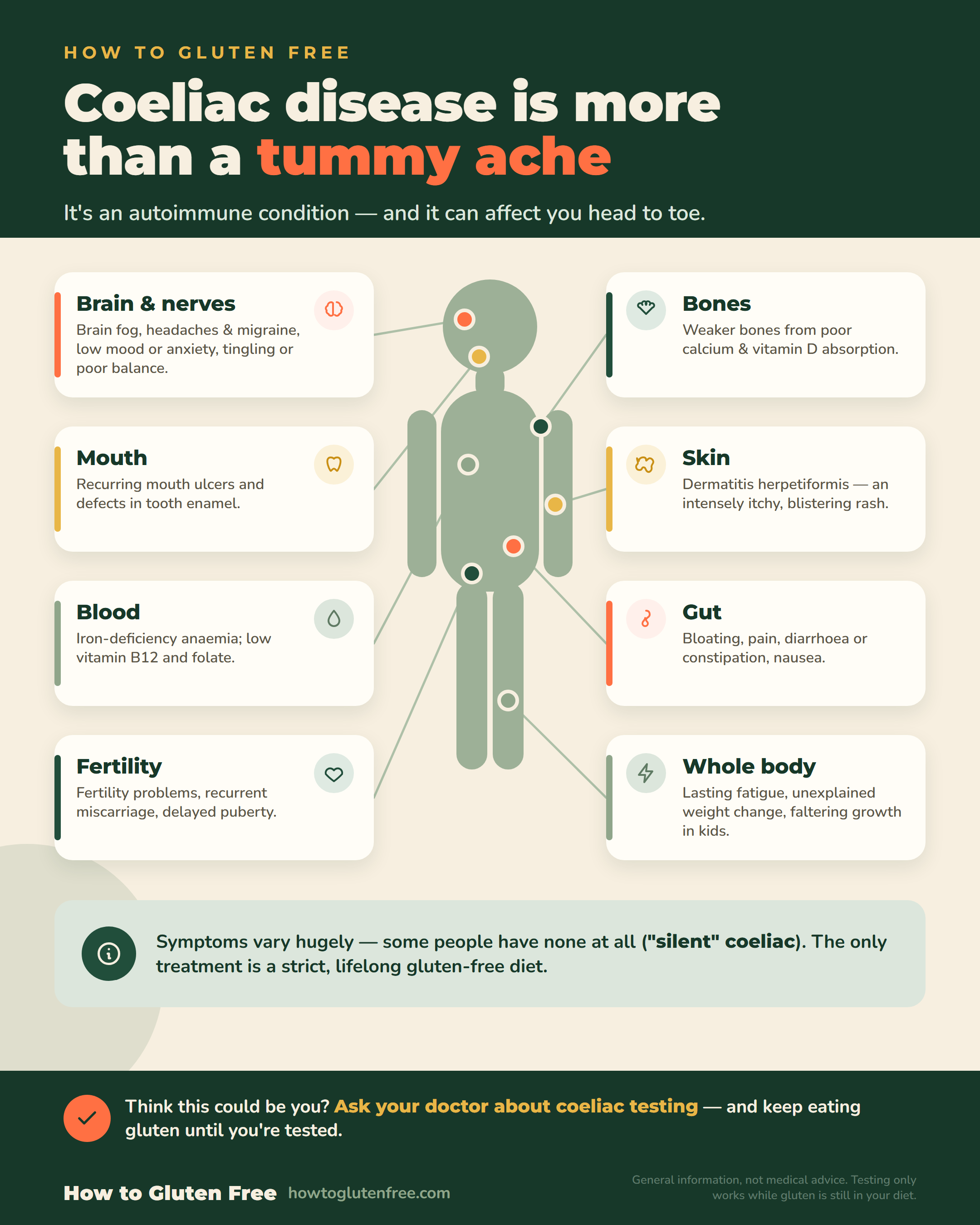
A coeliac diagnosis usually starts with the gut — the bloating, the fatigue, the biopsy that finds damage in the small intestine. So it can be surprising to learn that coeliac disease isn’t really a gut disease at all. It’s a systemic autoimmune condition: the immune reaction to gluten happens to be measured in the small intestine, but its effects can reach your skin, bones, blood, brain and beyond.
Here is the reassuring part, and it’s worth holding onto as you read: the treatment for all of it is the same one you’re already learning — a strict, lifelong gluten-free diet. Once gluten is removed, the small intestine heals and most of these issues improve or stabilise, while the routine follow-up your clinic offers is designed to catch anything that needs a closer look. This page is a map of where coeliac disease can reach, not a list of things that will happen to you.

Why coeliac disease is a whole-body condition
In coeliac disease, eating gluten triggers your immune system to attack the lining of the small intestine. That’s where the diagnosis is confirmed, and it’s why digestive symptoms are so common. But the immune process itself is systemic, and years of undiagnosed inflammation and poor nutrient absorption can leave traces elsewhere in the body. The guides below walk through the systems most often involved. Read them as associations and increased risks rather than certainties — most people with coeliac disease will only ever experience some of them, and the gluten-free diet is what turns the tide across the board.
Twelve in-depth guides, one per system. Below, each body system gets a short overview here, grouped so it’s easy to scan — and a link into its full guide, where we go into the single points: the specific signs, the tests, and exactly what helps.
Skin, bones & teeth
- Skin — dermatitis herpetiformis
Dermatitis herpetiformis is the skin form of coeliac disease — the same gluten-driven immune process, showing up as an intensely itchy, blistering rash, classically on the elbows, knees, buttocks and scalp. It’s diagnosed by a skin biopsy and clears over time on a strict gluten-free diet, sometimes with dapsone under specialist care while the diet takes effect. Read the full guide → - Bones — density & fracture risk
The part of the small intestine that absorbs calcium and vitamin D is often the most damaged, so undiagnosed coeliac disease is associated with lower bone density — osteopenia, and in some people osteoporosis. Bone density commonly improves on a gluten-free diet once any shortfall is corrected, and your team may arrange a DEXA scan in line with NICE and British Society of Gastroenterology guidance. Read the full guide → - Teeth — enamel & mouth
Coeliac disease can leave its mark on the mouth, especially when it develops in childhood while the teeth are still forming. Dental enamel defects — pitting, grooves or discolouration — are a recognised, permanent sign that can be an early clue to diagnosis, while recurrent mouth ulcers are common and often ease on a gluten-free diet. Read the full guide →
Blood & internal organs
- Blood — iron, B12 & folate
Iron-deficiency anaemia is one of the most common ways coeliac disease is picked up — sometimes the only sign, with no digestive symptoms at all — and low vitamin B12 or folate can occur too. These nutrients are absorbed in the upper small intestine, exactly where coeliac damage tends to concentrate, so levels usually recover as the gut heals on a gluten-free diet, with supplements if your clinician advises. Read the full guide → - Liver — raised enzymes
Some people with untreated coeliac disease have mildly raised liver enzymes on a blood test, sometimes called “coeliac hepatitis.” In most cases these settle back to normal within a year of starting a gluten-free diet, which is one reason abnormal liver blood tests are worth mentioning to your doctor. Coeliac disease is also associated, much less commonly, with autoimmune liver conditions. Read the full guide → - Spleen & vaccinations
In some adults, coeliac disease is associated with an under-active spleen (hyposplenism), which plays a role in fighting certain infections. For this reason Coeliac UK notes that some people may be advised to have additional vaccinations, such as the pneumococcal vaccine — whether that applies to you is a conversation for your GP. Read the full guide → - Kidneys — IgA nephropathy
There is a measured association between coeliac disease and IgA nephropathy, a kidney condition involving the same antibody family that’s active in coeliac disease. This is uncommon, and it’s mentioned for completeness rather than as something to worry about — any concerns about kidney health belong with your GP. Read the full guide →
Brain & wellbeing
- Brain & nerves
The nervous system can be involved too. Gluten ataxia — an immune-mediated effect on balance and coordination — and peripheral neuropathy (tingling or numbness in the hands and feet) are recognised, if uncommon, associations, and they can occur even without gut symptoms. Headaches, migraine and “brain fog” are reported more often, and the fog tends to lift on a gluten-free diet. Read the full guide → - Mental health
Living with a lifelong condition that touches every meal is genuinely demanding, and higher rates of anxiety and depression are reported among people with coeliac disease. That isn’t a weakness or something to push through alone — it’s common, understandable and treatable, and support from your GP or a coeliac-aware dietitian makes a real difference. Read the full guide →
Life stages
- Fertility & pregnancy
Undiagnosed or untreated coeliac disease has been associated with subfertility and with pregnancy complications such as low birth weight and preterm birth. Reassuringly, a well-managed gluten-free diet is linked to outcomes much closer to those of the general population, so it’s worth making sure coeliac disease is diagnosed and well controlled when planning a pregnancy. Read the full guide → - Children — growth & development
In children, coeliac disease can show up as faltering growth, short stature, delayed puberty or irritability rather than the classic tummy symptoms. The encouraging part is that children usually respond well to a gluten-free diet, often with catch-up growth once the gut heals, guided by a paediatrician or paediatric dietitian. Read the full guide →
Conditions that travel alongside
- Associated autoimmune conditions
Coeliac disease often keeps company with other autoimmune conditions, because they share genetic ground. Type 1 diabetes and autoimmune thyroid disease (such as Hashimoto’s) are the ones most commonly seen alongside it, which is why testing for one is often part of the picture when another is present. Coexisting doesn’t mean causing — your clinician can advise whether any screening makes sense for you. Read the full guide →
The whole-body picture at a glance
A quick summary — not a diagnosis. If anything here rings true for you, it’s a conversation to have with your medical team, not a conclusion to reach on your own.
| Body system | How coeliac can show up | What helps |
|---|---|---|
| Skin | Dermatitis herpetiformis: an itchy, blistering rash | Strict gluten-free diet; dapsone under specialist care while it takes effect |
| Bones | Lower bone density (osteopenia, osteoporosis) | Gluten-free diet; calcium and vitamin D; DEXA scan where advised |
| Blood | Iron-deficiency anaemia; low B12 or folate | Gut healing on a gluten-free diet; supplements if your clinician advises |
| Liver | Mildly raised liver enzymes | Usually normalise within a year of a gluten-free diet |
| Brain & nerves | Gluten ataxia, neuropathy, headaches, brain fog | Gluten-free diet; neurological assessment for persistent symptoms |
| Mental health | Higher rates of anxiety and depression | Support from your GP or dietitian; peer support; treatment where needed |
| Fertility & pregnancy | Subfertility and pregnancy complications when untreated | Diagnosis and a well-managed gluten-free diet |
| Immune / spleen | Reduced spleen function (hyposplenism) in some adults | Discuss vaccinations (e.g. pneumococcal) with your GP |
| Kidneys | Association with IgA nephropathy (uncommon) | GP assessment if there are concerns |
| Teeth | Enamel defects (from childhood); recurrent mouth ulcers | Ulcers ease on a gluten-free diet; regular dental care |
| Other autoimmune | Type 1 diabetes and autoimmune thyroid often coexist | Screening and monitoring as your clinician advises |
| Children | Faltering growth, short stature, delayed puberty | Catch-up growth on a gluten-free diet, guided by a paediatric team |
The reassuring part — what actually helps
If this page has covered a lot of ground, here’s the throughline to remember: coeliac disease is one condition with many possible expressions, and it has one core treatment — a strict, lifelong gluten-free diet, meaning food at or below the Codex standard of no more than 20 ppm (20 mg/kg) of gluten. Removing gluten lets the small intestine heal, and as it does, the knock-on effects across the body tend to improve or stabilise.
The rest is looked after by routine care. Most people with coeliac disease are offered an annual review with blood tests to check antibody levels and nutrition, plus a DEXA scan and other checks where guidelines advise them. A coeliac-aware dietitian is one of the most useful people to have on your side — for getting the diet right, filling nutritional gaps, and keeping an eye on the wider picture. Our follow-up care guide walks through what that looks like year to year.
See your GP promptly if symptoms are severe, persistent or getting worse, or if new symptoms appear — those are reasons for assessment, not for filing everything under “just coeliac.” With the diet in place and a bit of monitoring, the whole-body reach of coeliac disease becomes something that’s watched and managed, not something that runs the show.
Key takeaways
- Coeliac disease is a systemic autoimmune condition — its effects can reach beyond the gut, into skin, bones, blood, nerves and more.
- These are associations and increased risks, not certainties: most people will only ever experience some of them.
- The treatment is the same throughout: a strict, lifelong gluten-free diet (no more than 20 ppm), which lets the body heal so most issues improve or stabilise.
- Routine follow-up — annual bloods, a DEXA scan where advised, and a coeliac-aware dietitian — is there to catch the rest.
Keep exploring
- Your First 90 Days With Coeliac Disease — a phase-by-phase roadmap for settling into life after diagnosis.
- Coeliac Follow-Up Care — your reviews, blood tests and nutrient checks, explained.
- Coeliac Diagnosis & Medical FAQ — the questions people ask around testing and diagnosis.
- Coeliac Anxiety and Isolation — when food starts to feel stressful, and what helps.
- Eating Out Safely — a calm, repeatable process for any restaurant, anywhere.
Frequently asked questions
Can coeliac disease affect more than the gut?
Yes. Coeliac disease is a systemic autoimmune condition. The damage that confirms the diagnosis is in the small intestine, but the same immune process is associated with effects on the skin, bones, blood, liver, nervous system and more. Most people experience only some of these, and they’re risks and associations rather than certainties.
Do these problems go away on a gluten-free diet?
Many improve or stabilise once gluten is removed and the gut heals — raised liver enzymes and iron levels often normalise, bone density can recover, and brain fog tends to lift. A few things, such as dental enamel defects formed in childhood, are permanent. Routine follow-up is there to monitor the rest. This is general information, and your own situation is one for your clinician.
Should I be screened for other conditions?
Your clinician may check for conditions that commonly travel with coeliac disease, such as autoimmune thyroid disease, and arrange follow-up blood tests and a DEXA bone-density scan where guidelines advise. What’s right for you depends on your history, so ask your GP or gastroenterologist.
Is dermatitis herpetiformis the same as coeliac disease?
Dermatitis herpetiformis is the skin manifestation of coeliac disease — the same gluten-driven immune process, expressed as an itchy, blistering rash. It’s managed with a strict lifelong gluten-free diet, sometimes with dapsone under specialist care while the diet takes effect.
This page is general information, not medical advice. Coeliac disease is individual, and the conditions described here are associations and risks rather than certainties — discuss your own situation with your GP, gastroenterologist or a coeliac-aware dietitian.
Sources & standards: Coeliac UK (associated conditions, bone health, dermatitis herpetiformis and the gluten-free diet); NICE guideline NG20 (coeliac disease: recognition, assessment and management); the British Society of Gastroenterology (BSG) guidelines on the diagnosis and management of adult coeliac disease; the Codex Alimentarius gluten-free standard of no more than 20 ppm (20 mg/kg) of gluten; and AOECS (Association of European Coeliac Societies). Last verified: 2026-07-21.
Reviewed against the HTGF methodology — every claim sourced, every listing tiered and dated. This article is practical guidance, not medical advice.
Gluten-free confidence in your inbox.
Practical tips, new guides and community stories. No spam. Unsubscribe anytime.