Coeliac Disease and Anaemia: Iron, B12 and Folate
For a lot of people, coeliac disease is found not in the gut but in the blood. You feel tired in a way that sleep doesn’t fix, maybe a little breathless on the stairs or paler than usual — and a routine blood test comes back showing iron-deficiency anaemia. Track down why the iron is low, and coeliac disease turns out to be the reason. It’s one of the most common ways the condition comes to light, often long before anyone suspects the small intestine.
This page goes deeper on the blood chapter of our Coeliac Beyond the Gut guide: what iron, vitamin B12 and folate do, why coeliac disease so often pulls them down, and — the reassuring part — why they usually climb back up once you’re on a gluten-free diet. Read it as an association and a common presentation, not something to worry about happening to you.
The short answer
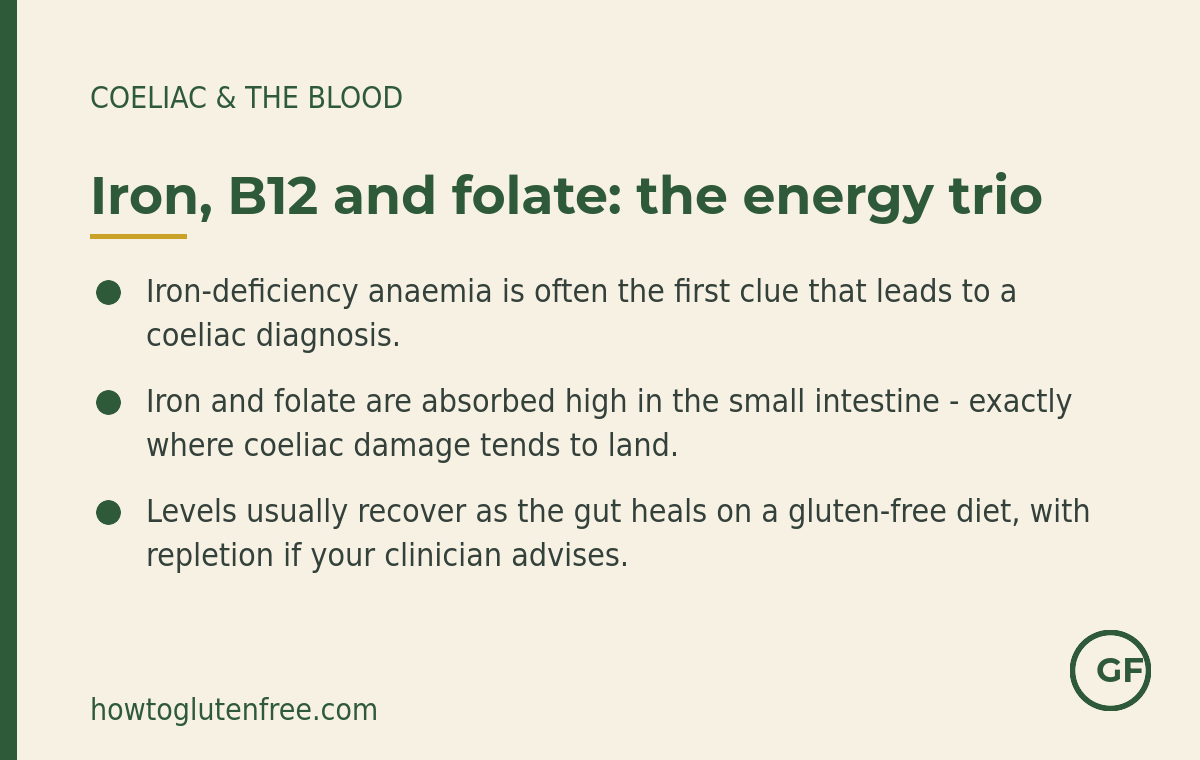
Iron-deficiency anaemia is one of the most common presentations of coeliac disease, and often the reason someone is tested in the first place. Low folate is frequent too, and vitamin B12 can dip in some people. These nutrients are absorbed in the upper small intestine, exactly where coeliac damage concentrates, so levels usually recover as the gut heals on a strict gluten-free diet — helped along by supplements while your stores rebuild, if your GP or dietitian recommends them.
Why anaemia is so often the first sign
Iron, folate and vitamin B12 are the raw materials your body uses to make healthy red blood cells. When they run short, you can become anaemic — fewer or smaller red cells, less oxygen carried around — which shows up as fatigue, breathlessness, pale skin, brittle nails or a racing heart. In coeliac disease, the reason those raw materials run short is absorption: the gluten-driven immune reaction damages the lining of the upper small intestine, and that is precisely where iron and folate are taken up from food.
Because the damage can be quietly doing this for years, anaemia is sometimes the only sign of coeliac disease — no bloating, no diarrhoea, no obvious tummy trouble at all. That’s why national guidance takes unexplained anaemia seriously: NICE guideline NG20 recommends offering a test for coeliac disease to anyone with unexplained iron-deficiency anaemia, and Coeliac UK lists it among the most common ways the condition is picked up in adults. If your iron is low and no one can say why, coeliac disease is one of the things worth ruling in or out.
The three nutrients that most often run low
Iron — the usual one
Iron is absorbed mainly in the duodenum and the very start of the small intestine — the stretch that tends to be most inflamed in untreated coeliac disease. So iron-deficiency anaemia is the classic blood finding. It can leave you drained, foggy and cold-handed, and it responds well once the gut starts to heal and, where needed, iron stores are topped up under medical guidance.
Folate — often low too
Folate (vitamin B9) is absorbed a little further along, in the upper jejunum, which is also frequently affected. Low folate is common at diagnosis and can cause a different pattern of anaemia, with larger-than-normal red cells. One thing worth knowing: in many countries ordinary wheat flour and breakfast cereals are fortified with folic acid and iron, so a gluten-free diet can actually deliver less of both unless you plan for it. That’s one of the quiet reasons a coeliac-aware dietitian is so useful.
Vitamin B12 — less common, still worth checking
Vitamin B12 is absorbed lower down, in the last part of the small intestine (the terminal ileum), which coeliac disease damages less often. So B12 deficiency is less common than low iron or folate — but it does happen, and because it can affect nerves as well as blood, it’s part of the standard panel your clinic checks. If it’s low, it’s easily corrected.
What your blood tests are checking
You don’t need to decode the numbers yourself — your GP does that — but it helps to know what’s being looked at. A full blood count measures your haemoglobin and the size of your red cells (small cells point to iron; large cells point to folate or B12). Ferritin shows how much iron you have in the bank, while folate and B12 are measured directly. Most people with coeliac disease are offered an annual review that includes these, so shortfalls get spotted and put right over time — something Coeliac UK and the British Society of Gastroenterology both build into follow-up care.
How it usually gets better
Here’s the encouraging throughline. The core treatment for coeliac disease — a strict, lifelong gluten-free diet, meaning food at or below the Codex standard of no more than 20 ppm (20 mg/kg) of gluten — lets the small intestine heal. As the lining recovers, it goes back to absorbing iron, folate and B12 properly, and blood levels tend to rise on their own over the following months. Where stores are very low, your clinician may add a course of iron, folate or B12 to speed things up while the gut catches up, then recheck your bloods to confirm the trend.
A word on supplements: it’s best not to start high-dose iron on your own. Too much can upset your stomach and can muddy the picture your doctor is trying to read, so let your GP or dietitian guide the dose and check it’s working. Alongside any tablets, building iron- and folate-rich foods into everyday meals — pulses, eggs, leafy greens, nuts and seeds, and pairing plant iron with a little vitamin C to help it absorb — keeps the tank topped up naturally.
Iron, folate and B12 at a glance
| Nutrient | Why it can drop in coeliac disease | What the blood test looks at | How it’s usually put right |
|---|---|---|---|
| Iron | Absorbed in the duodenum — the most damaged area in untreated coeliac disease | Haemoglobin, red-cell size (MCV), ferritin | Gut healing on a gluten-free diet; iron supplements if your clinician advises |
| Folate (B9) | Absorbed in the upper jejunum; a gluten-free diet may also be lower in fortified folic acid | Serum or red-cell folate; larger red cells on the count | Diet, healing gut, and folic acid where recommended |
| Vitamin B12 | Absorbed lower down (terminal ileum), which is affected less often — so deficiency is less common | Serum B12 (part of the standard panel) | B12 supplements or injections if levels are low |
When to see your GP
Unexplained tiredness or anaemia is always worth investigating rather than pushing through — so if you feel persistently drained, breathless or run-down, ask your GP for a blood test and let them find the cause. If coeliac disease hasn’t been ruled out, mention it, because testing is straightforward.
If you already have a coeliac diagnosis and your iron or folate stays low despite a strict gluten-free diet, that’s a flag to follow up too. Sometimes it points to small amounts of gluten still getting in; sometimes it’s a separate cause entirely, such as heavy periods or another gut issue. Either way, it’s a conversation for your GP, gastroenterologist or dietitian — not something to file under “just coeliac.”
The bottom line
- Iron-deficiency anaemia is one of the most common presentations of coeliac disease — sometimes the only one, with no gut symptoms.
- Low folate is frequent, and vitamin B12 can dip in some people; all three are checked at your annual review.
- These nutrients are absorbed high in the small intestine, where coeliac damage concentrates — so levels usually recover as the gut heals on a gluten-free diet.
- Supplements can help while your stores rebuild, but let your GP or dietitian guide the dose and confirm it’s working.
Keep exploring
- Coeliac Beyond the Gut — the whole-body map this page belongs to.
- Coeliac Disease and Your Liver — raised liver enzymes that usually settle on a gluten-free diet.
- Coeliac Disease, the Spleen and Vaccinations — hyposplenism and when vaccines may be offered.
- Coeliac Follow-Up Care — your annual review, blood tests and nutrient checks, explained.
- Your First 90 Days With Coeliac Disease — settling into life after diagnosis.
- Coeliac Diagnosis & Medical FAQ — the questions people ask around testing.
Frequently asked questions
Is anaemia a common sign of coeliac disease?
Yes — iron-deficiency anaemia is one of the most common ways coeliac disease is found in adults, and national guidance (NICE NG20) recommends testing for coeliac disease when someone has unexplained iron-deficiency anaemia. It can be the only sign, with no digestive symptoms at all.
Will my iron levels go back to normal on a gluten-free diet?
Usually, yes. Once gluten is removed and the small intestine heals, it absorbs iron properly again and levels tend to rise over the following months. Your clinician may add a short course of iron to rebuild your stores and then recheck your bloods to confirm it’s working.
Do I need to take iron or folate supplements?
Sometimes, but not always — and it’s best not to start high-dose iron on your own. Your GP or a coeliac-aware dietitian will decide based on your blood results, guide the dose, and check it’s helping. A gluten-free diet can be lower in fortified iron and folic acid, so food choices matter too.
Can I have coeliac disease with anaemia but no stomach symptoms?
Yes. Many people are diagnosed after an unexplained anaemia rather than gut symptoms. The immune reaction to gluten can quietly reduce nutrient absorption for years without obvious digestive trouble, which is why unexplained anaemia is worth investigating.
This page is general information, not medical advice. Anaemia and low nutrient levels are associations and common presentations of coeliac disease rather than certainties, and everyone’s situation is different — discuss your own blood results and any supplements with your GP, gastroenterologist or a coeliac-aware dietitian.
Sources & standards: Coeliac UK (iron, vitamin B12 and folate; anaemia as a presentation; annual review and the gluten-free diet); NICE guideline NG20 (coeliac disease: recognition, assessment and management, including testing in unexplained iron-deficiency anaemia); the British Society of Gastroenterology (BSG) guidelines on the diagnosis and management of adult coeliac disease and follow-up; the Codex Alimentarius gluten-free standard of no more than 20 ppm (20 mg/kg) of gluten; and AOECS (Association of European Coeliac Societies). Last verified: 2026-07-21.
Reviewed against the HTGF methodology — every claim sourced, every listing tiered and dated. This article is practical guidance, not medical advice.
Gluten-free confidence in your inbox.
Practical tips, new guides and community stories. No spam. Unsubscribe anytime.