Coeliac Disease, the Spleen and Vaccinations
Of all the places coeliac disease can reach, the spleen is one of the least talked about — and one of the easiest to feel calm about. In some adults with coeliac disease the spleen works a little less effectively than usual. It rarely causes any symptoms, and the practical upshot is refreshingly simple: a short conversation with your GP about whether one or two vaccinations would be sensible for you.
This page expands the immune system and spleen chapter of our Coeliac Beyond the Gut guide. It explains what an under-active spleen (hyposplenism) is, why it matters a little, and how to think about the vaccination question — framed, as Coeliac UK does, as something that may be offered and worth discussing with your GP, rather than a blanket recommendation for everyone.
The short answer
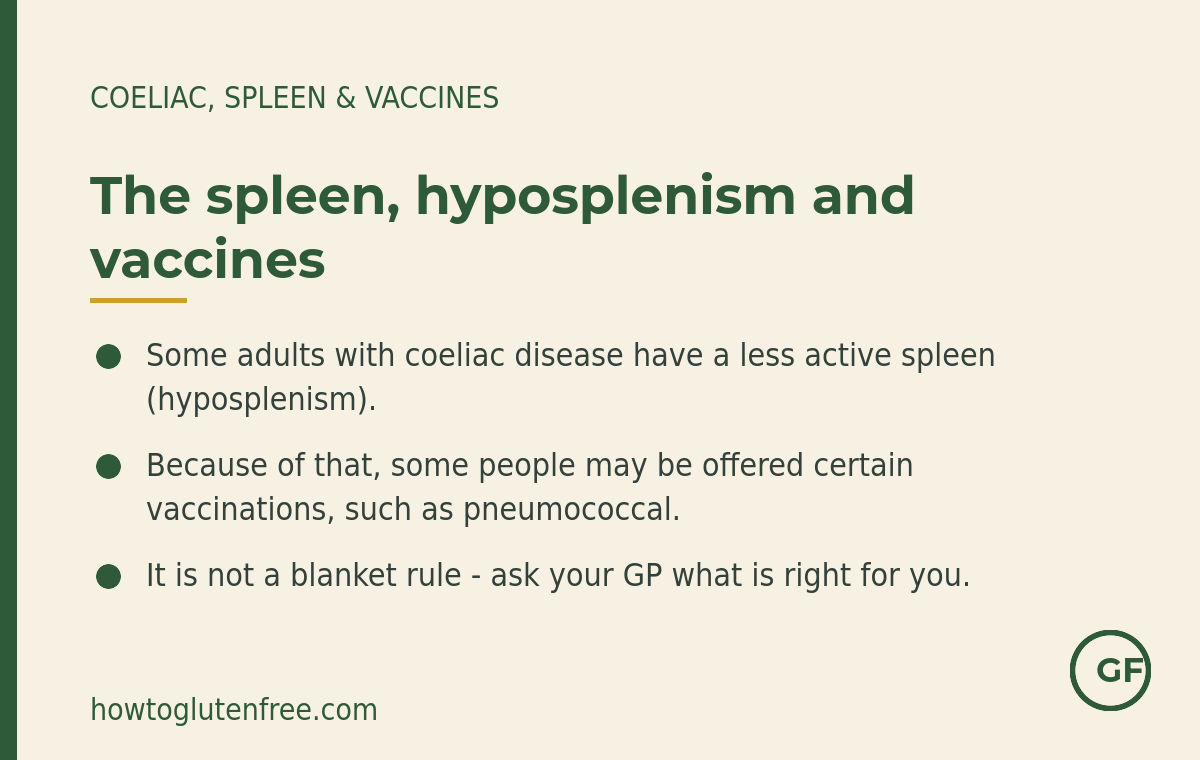
Some adults with coeliac disease have reduced spleen function (hyposplenism), which can slightly lower the body’s defences against certain infections. Because of that, Coeliac UK notes that some people may be advised to have particular vaccinations, such as the pneumococcal vaccine. This is an individual decision, not a blanket rule for everyone with coeliac disease — so the right step is simply to ask your GP what, if anything, is recommended for you. Meanwhile, coeliac disease does not stop you having your routine vaccinations as normal.
What the spleen does
The spleen is a small organ tucked under the left ribs that quietly does two jobs: it filters worn-out cells from your blood, and it plays a part in your immune defences — particularly against a group of bacteria with a protective outer coat, known as encapsulated bacteria (the pneumococcus is the best-known example). When the spleen is fully active, you don’t notice any of this. When it’s a little less active, defence against those specific bacteria can be slightly weaker, which is the whole reason vaccinations sometimes come up.
Hyposplenism and coeliac disease
In some adults, coeliac disease is associated with reduced spleen function, a state called hyposplenism. It tends to be more likely with long-standing or undiagnosed disease, and it’s often mild and without symptoms — many people would never know unless it were specifically looked for. It’s an association rather than something that happens to everyone with coeliac disease, and getting on a gluten-free diet is part of keeping your overall health on track. The reason it’s worth knowing about isn’t alarm; it’s that it points to one small, sensible precaution.
What this means for vaccinations
Here’s the part people most want clear guidance on, so let’s keep it precise. Because a less-active spleen can weaken defence against certain infections, Coeliac UK notes that some people with coeliac disease may be advised to have additional vaccinations, such as the pneumococcal vaccine. The important words are “may be advised” and “some people.” This is not a universal recommendation, and it isn’t something to organise in a rush — it’s a question to raise with your GP, who can weigh your individual situation and your country’s immunisation guidance.
It’s just as important to say what this is not. Coeliac disease doesn’t ban or complicate your routine vaccines — you can follow your national immunisation schedule as normal. There’s nothing here to worry about between now and your next GP visit; the vaccination question is a small piece of good housekeeping, not an emergency.
Vaccination questions to raise with your GP
| Vaccine | Why it may come up | Who it’s usually for |
|---|---|---|
| Pneumococcal | Protects against pneumococcal infection, which matters more if spleen function is reduced | May be offered to some adults with coeliac disease — discuss with your GP |
| Annual flu | Commonly offered to people with long-term conditions | Ask whether you’re eligible where you live |
| Routine schedule | Coeliac disease doesn’t stop you having standard vaccines | Everyone — follow your national immunisation schedule as normal |
How to approach it
The easiest moment to sort this out is your annual coeliac review or any routine GP appointment. You could simply ask: “Given my coeliac disease, do you recommend the pneumococcal vaccine for me, or any others?” That hands the decision to the person best placed to make it, using your history and local guidance. If the answer is yes, it’s a quick jab; if it’s no, you’ve got clarity. Either way, it’s off your mind.
The bottom line
- Some adults with coeliac disease have reduced spleen function (hyposplenism), which is usually mild and symptomless.
- Because of it, Coeliac UK notes that some people may be advised to have certain vaccinations, such as the pneumococcal vaccine.
- This is an individual decision, not a blanket recommendation — the right move is to ask your GP what’s recommended for you.
- Coeliac disease doesn’t stop your routine vaccinations; you can follow your national immunisation schedule as normal.
Keep exploring
- Coeliac Beyond the Gut — the whole-body map this page belongs to.
- Coeliac Disease and Anaemia — iron, B12 and folate, and why anaemia is often the first clue.
- Coeliac Disease and Your Liver — raised liver enzymes that usually settle on a gluten-free diet.
- Coeliac Follow-Up Care — your annual review, blood tests and nutrient checks, explained.
- Your First 90 Days With Coeliac Disease — settling into life after diagnosis.
- Coeliac Diagnosis & Medical FAQ — the questions people ask around testing.
Frequently asked questions
Does coeliac disease affect the spleen?
In some adults it can. Coeliac disease is associated with reduced spleen function (hyposplenism), which is usually mild and causes no symptoms. It’s an association rather than something everyone with coeliac disease develops.
Do people with coeliac disease need extra vaccinations?
Not as a blanket rule. Because a less-active spleen can lower defence against certain infections, Coeliac UK notes that some people may be advised to have particular vaccinations, such as the pneumococcal vaccine. Whether it applies to you is a question for your GP.
Which vaccine is usually discussed, and is it required?
The pneumococcal vaccine is the one most often mentioned, because of its relevance when spleen function is reduced; the annual flu vaccine may also be offered. Neither is a universal requirement for coeliac disease — they’re offered based on your individual situation and local immunisation guidance.
Can I have my routine vaccinations as normal with coeliac disease?
Yes. Coeliac disease doesn’t stop you following your national immunisation schedule — your routine vaccines go ahead as usual. This is general information; if you have any specific concerns, your GP can advise.
This page is general information, not medical advice. Reduced spleen function and vaccination needs are individual — whether any vaccination is right for you is a decision for your GP, based on your history and your country’s immunisation guidance.
Sources & standards: Coeliac UK (hyposplenism and the spleen; vaccinations that may be offered, including pneumococcal; the gluten-free diet); NICE guideline NG20 (coeliac disease: recognition, assessment and management); the British Society of Gastroenterology (BSG) guidelines on the diagnosis and management of adult coeliac disease; the Codex Alimentarius gluten-free standard of no more than 20 ppm (20 mg/kg) of gluten; and AOECS (Association of European Coeliac Societies). Vaccination decisions also follow national immunisation guidance. Last verified: 2026-07-21.
Reviewed against the HTGF methodology — every claim sourced, every listing tiered and dated. This article is practical guidance, not medical advice.
Gluten-free confidence in your inbox.
Practical tips, new guides and community stories. No spam. Unsubscribe anytime.