Coeliac Disease and Your Liver: Raised Enzymes and Coeliac Hepatitis
Sometimes coeliac disease first shows up in an unexpected place: a routine blood test where the liver numbers come back a little high. It can be unsettling to hear that your liver enzymes are raised — the word “liver” sounds serious — but in the context of coeliac disease this is usually a mild, reversible finding. For some people, in fact, those slightly high numbers are the clue that leads to the coeliac diagnosis in the first place.
This page expands the liver chapter of our Coeliac Beyond the Gut guide: what raised liver enzymes mean, the mild “coeliac hepatitis” that usually settles on a gluten-free diet, and the less-common association with autoimmune liver conditions. As with the rest of the guide, treat this as an association and a possibility, not something that’s bound to happen to you.
The short answer
A number of people with untreated coeliac disease have mildly raised liver enzymes (transaminases) — a pattern sometimes called “coeliac hepatitis.” In most cases these settle back to normal within about a year of starting a strict gluten-free diet, which is why abnormal liver blood tests are worth mentioning to your doctor. Coeliac disease is also linked, less commonly, to autoimmune liver conditions; those need their own assessment, and your clinician can advise whether any further checks make sense.
What “raised liver enzymes” actually means
Liver enzymes such as ALT and AST (the transaminases) live inside liver cells. When those cells are irritated or inflamed, a little of the enzyme leaks into the blood, so the level on your test creeps up. A mild rise is common and has many possible causes — it’s a signal to look, not a diagnosis in itself. In coeliac disease, the systemic inflammation that comes with untreated gut damage is one of those causes, and it usually produces only a gentle, symptomless bump in the numbers.
Coeliac hepatitis — the liver’s response to gluten
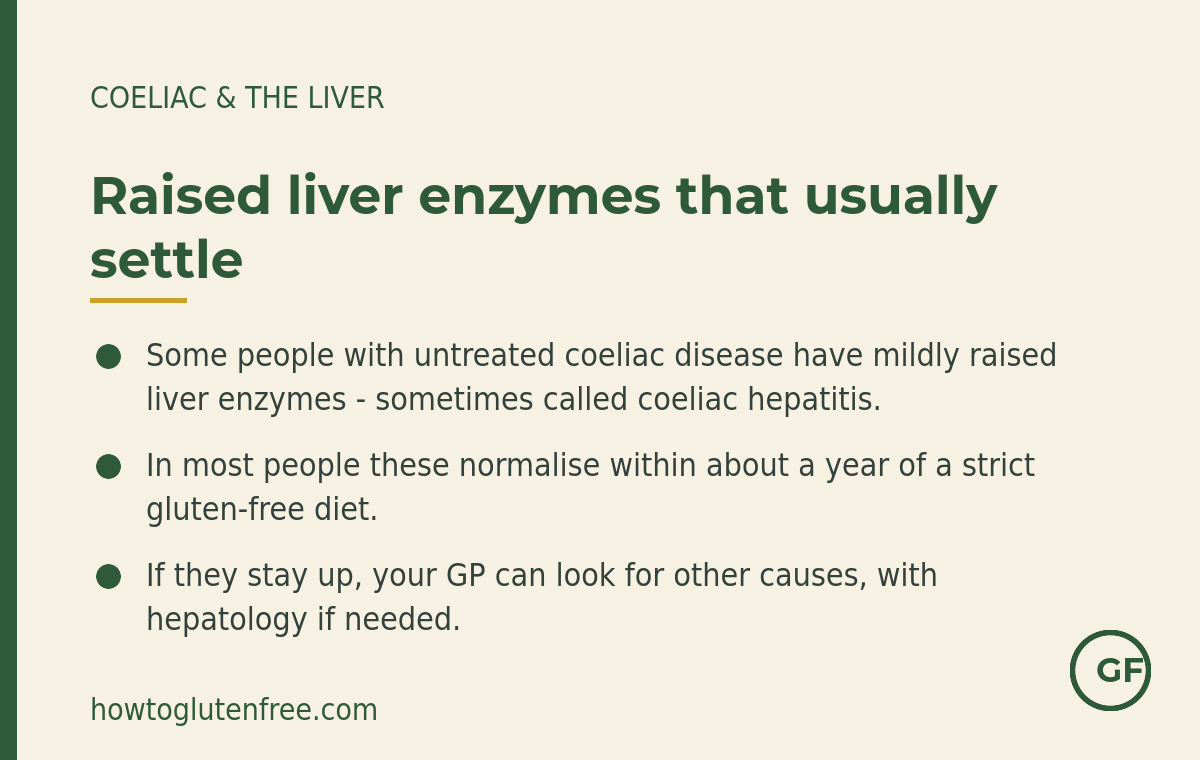
When mildly raised transaminases are down to untreated coeliac disease, clinicians sometimes call it coeliac hepatitis (or coeliac hepatopathy). It’s typically mild, causes no symptoms, and is picked up only because someone happened to run a blood test. The reassuring headline is that it usually reverses on its own: in most people the enzymes normalise within about a year of a strict gluten-free diet, as the gut heals and the systemic inflammation settles.
This works in the other direction too, which is why it matters. If someone has persistently raised transaminases and no one can explain why, testing for coeliac disease is a sensible step — NICE guideline NG20 lists unexplained abnormal liver blood tests among the reasons to consider a coeliac test. So a set of stubbornly high liver numbers is sometimes the thread that, when pulled, leads to a coeliac diagnosis and a treatment that fixes both.
The other side — autoimmune liver conditions
Because coeliac disease is autoimmune, it shares genetic ground with a handful of autoimmune conditions that affect the liver — chiefly autoimmune hepatitis, primary biliary cholangitis and primary sclerosing cholangitis. These are recognised associations, but they are much less common than the mild coeliac hepatitis above, and it’s worth being clear about one key difference: unlike coeliac hepatitis, these conditions don’t simply melt away on a gluten-free diet. They have their own diagnosis and their own treatment, usually guided by a liver specialist.
This is mentioned for completeness rather than as a cause for worry. For most people with raised enzymes and coeliac disease, the explanation is the reversible kind. But it’s the reason your clinician keeps an eye on liver blood tests: if the numbers don’t behave as expected on a gluten-free diet, they can look a little further.
Two ways the liver can be involved
| Picture | What it is | Typical course | What helps |
|---|---|---|---|
| Coeliac hepatitis | Mildly raised transaminases (ALT/AST) linked to untreated coeliac disease | Usually normalises within about a year of a strict gluten-free diet | Strict gluten-free diet; recheck bloods at follow-up |
| Autoimmune liver disease | Separate autoimmune conditions (autoimmune hepatitis, PBC, PSC) that can coexist | Much less common; does not resolve on diet alone | Hepatology assessment and its own treatment; keep coeliac well managed too |
How it usually gets better
The core treatment is the same one that runs through the whole of coeliac care: a strict, lifelong gluten-free diet, meaning food at or below the Codex standard of no more than 20 ppm (20 mg/kg) of gluten. Remove gluten, let the small intestine heal, and the mild liver inflammation of coeliac hepatitis typically settles with it — often within a year. Your clinic will usually recheck your liver enzymes as part of routine follow-up, so you can watch the numbers come down rather than wondering about them.
When to see your GP
Mention any abnormal liver blood test to your doctor, and if you have coeliac disease it’s worth flagging so both are considered together. See your GP more promptly if your enzymes stay raised after six months to a year of a genuinely strict gluten-free diet, if they climb rather than fall, or if you notice symptoms such as yellowing of the skin or eyes, itching, dark urine or pain over the liver. Those are reasons to look further — often a referral to hepatology — rather than to assume everything is down to coeliac disease.
The bottom line
- Mildly raised liver enzymes are a recognised feature of untreated coeliac disease — sometimes called coeliac hepatitis.
- In most people they normalise within about a year of a strict gluten-free diet, and unexplained raised enzymes are a reason to test for coeliac disease.
- Coeliac disease is also linked, much less commonly, to autoimmune liver conditions, which need their own assessment and don’t resolve on diet alone.
- If your enzymes stay up on a strict gluten-free diet, or you develop liver symptoms, see your GP — hepatology can look for another cause.
Keep exploring
- Coeliac Beyond the Gut — the whole-body map this page belongs to.
- Coeliac Disease and Anaemia — iron, B12 and folate, and why anaemia is often the first clue.
- Coeliac Disease, the Spleen and Vaccinations — hyposplenism and when vaccines may be offered.
- Coeliac Follow-Up Care — your annual review, blood tests and nutrient checks, explained.
- Your First 90 Days With Coeliac Disease — settling into life after diagnosis.
- Coeliac Diagnosis & Medical FAQ — the questions people ask around testing.
Frequently asked questions
Can coeliac disease affect your liver?
Yes. A number of people with untreated coeliac disease have mildly raised liver enzymes on a blood test. It’s usually mild and symptomless, and it reflects the systemic inflammation of untreated coeliac disease rather than lasting liver damage.
What is coeliac hepatitis?
Coeliac hepatitis (or coeliac hepatopathy) is the name for mildly raised liver enzymes caused by untreated coeliac disease. In most people it normalises within about a year of starting a strict gluten-free diet, as the gut heals and inflammation settles.
Will raised liver enzymes go back to normal on a gluten-free diet?
Usually, when the cause is coeliac hepatitis. Most people see their enzymes return to normal within about a year on a strict gluten-free diet, and your clinic will typically recheck them at follow-up. If they don’t settle, that’s a reason to look for another cause.
Should I be worried about autoimmune liver disease?
For most people with raised enzymes and coeliac disease, the explanation is the reversible kind. Autoimmune liver conditions are a recognised but much less common association. This is general information — if you’re concerned, your GP or a liver specialist can advise what, if anything, needs checking.
This page is general information, not medical advice. Liver involvement in coeliac disease is an association rather than a certainty, and everyone’s situation is different — discuss your own liver blood tests with your GP, gastroenterologist, hepatologist or a coeliac-aware dietitian.
Sources & standards: Coeliac UK (associated conditions and liver involvement; the gluten-free diet and follow-up); NICE guideline NG20 (coeliac disease: recognition, assessment and management, including testing where liver blood tests are unexplained); the British Society of Gastroenterology (BSG) guidelines on the diagnosis and management of adult coeliac disease; the Codex Alimentarius gluten-free standard of no more than 20 ppm (20 mg/kg) of gluten; and AOECS (Association of European Coeliac Societies). Last verified: 2026-07-21.
Reviewed against the HTGF methodology — every claim sourced, every listing tiered and dated. This article is practical guidance, not medical advice.
Gluten-free confidence in your inbox.
Practical tips, new guides and community stories. No spam. Unsubscribe anytime.