Ingredients
Method
- Make the dough. Whisk the three flours and starches with the sugar, baking powder, salt and xanthan until thoroughly combined. Separately whisk the olive oil, wine and egg. Stir the wet ingredients into the dry, then gently knead together in the bowl.
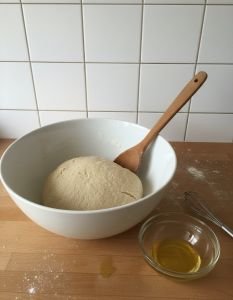
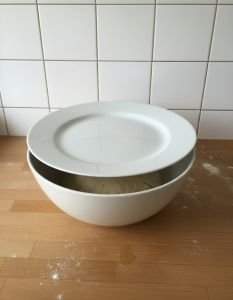
- Adjust and rest. The dough should feel soft and pliable, without smearing onto your fingers. If it breaks apart when pressed flat, knead in the extra water a little at a time, using only what it needs. Cover and rest at room temperature for 25 minutes.
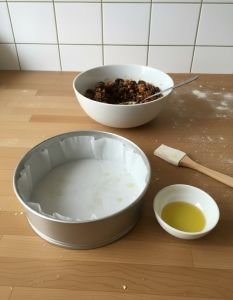
- Prepare the filling during the rest. Cover the raisins with the measured hot water for 10 minutes. Drain thoroughly and pat dry. Mix with the chopped walnuts, filling honey, orange zest, cinnamon and cloves. The mixture should be sticky, with no liquid pooling underneath.

- Prepare the oven and tin. Heat the oven to 180 °C (160 °C fan) / 350 °F. Line the base and sides of a 20 cm / 8 in round shallow cake tin with baking paper. Use a little of the assembly oil to grease the paper lightly.
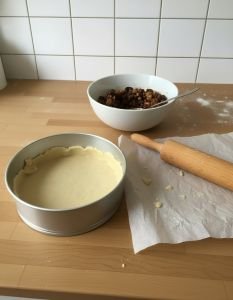
- Make the pastry base. Weigh off 110 g dough and keep the remainder covered. Roll the smaller portion between two sheets of baking paper into a 22 cm circle, about 2 to 3 mm thick. Peel away the top sheet and use the lower sheet to help invert the dough into the tin. Remove that sheet, then ease the dough across the base and slightly up the sides. Patch any cracks with the overlapping dough.
- Roll the strips. Divide the remaining dough into seven equal pieces. Working with one piece at a time, roll between baking-paper sheets into a strip approximately 8 × 30 cm and 2 mm thick. Keep the other pieces covered. Brush each strip very lightly with the remaining assembly oil.

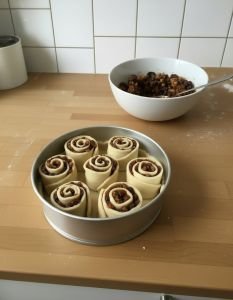
- Fill and form the roses. Divide the filling into seven portions. Spread one portion along one long half of a strip, leaving a narrow clear margin at the ends. Fold the other long half over it to make a strip approximately 4 cm wide. Leave the two long edges unsealed. With the folded edge resting on the paper and the open edges facing upwards, loosely coil the strip from one short end into a rose. Use the paper to support the dough as you turn it. Pinch the outer end gently against the coil.

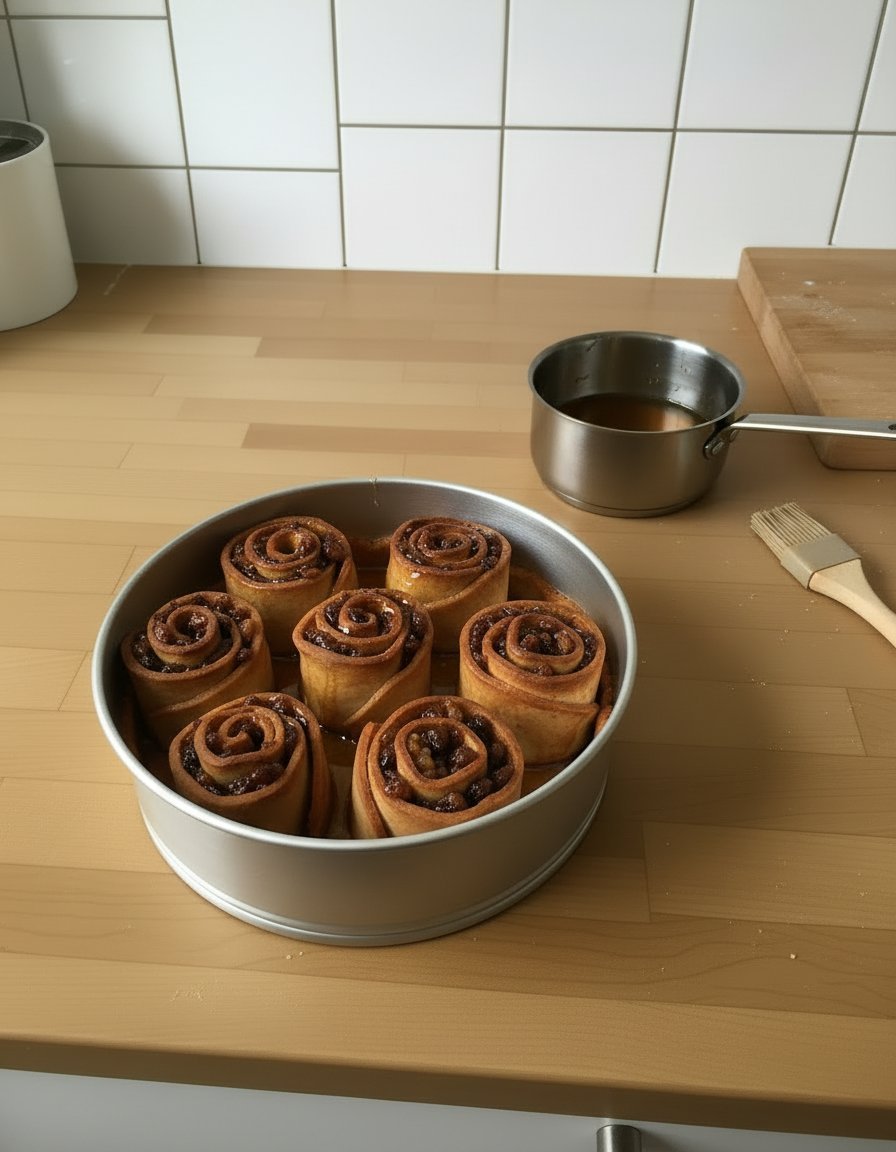
- Arrange and bake. Set one rose in the centre of the pastry base and six around it, open edges facing upwards. Leave a little breathing room between them. Bake for 50 to 55 minutes, until the pastry edges are golden and the inner folds look set rather than wet. If the tops colour early, loosely cover with foil for the remaining baking time.
- Glaze and cool. Gently warm the finishing honey just until runny, then brush over the hot roses. Cool in the tin for 60 minutes before lifting out carefully. Cut into wedges with a sharp serrated knife, supporting the pastry as you slice.

Notes
Coeliac notes
• Flour and starch: rice, sorghum and tapioca are naturally gluten-free, but they can be milled where wheat is milled. Buy the rice flour, the sorghum flour and the tapioca starch labelled gluten-free (milling cross-contact).
• Check the labels: a recipe that is called gluten-free does not replace the checks on the flours, the starch, the xanthan and the baking powder. Baking powder, xanthan, raisins, walnuts, honey and spices can have gluten-containing ingredients in their ingredients list. Choose a product labelled gluten-free if you cannot tell whether an ingredient is suitable. What a "may contain" line means depends on the country you shop in: see our may contain rules by country.
• Your kitchen: use clean scales, bowls, baking paper, rolling equipment and work surfaces, away from loose wheat flour.
• Allergens: contains egg and walnuts. If you avoid sulphites, check the labels of the raisins and the wine: sulphites above 10 mg/kg or 10 mg/litre are on the EU list of substances causing allergies or intolerances (Regulation (EU) No 1169/2011, Annex II). Keep ingredient packaging available when sharing. Baking tips
• The flours and starch weigh 300 g in total, so the 3.6 g of xanthan is 1.2 g per 100 g. The filling uses chopped walnuts, not walnut meal, so the nuts are not counted. Weigh the xanthan on a precision scale.
• This is a tender short pastry, so support each strip with baking paper while shaping. Roll a fresh strip if the dough begins to dry, and keep waiting portions covered.
• Chop the walnuts finely enough that they do not puncture the dough, while keeping their texture. Do not grind them into flour.
• Serve at room temperature. For transport, cool completely and pack in a rigid, baking-paper-lined container so the roses cannot slide or be crushed.