
Ingredients
Method
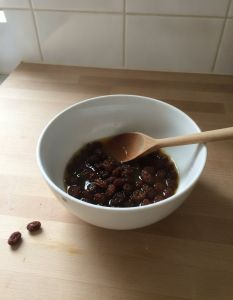
- Soak the raisins: Mix the raisins with the rum or orange juice. Cover and refrigerate for 8 hours, stirring once or twice. Take them out while you prepare the other ingredients, and keep any soaking liquid the raisins have not absorbed.
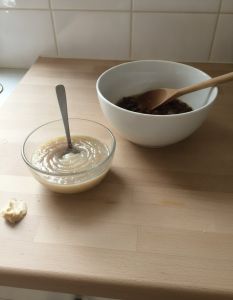
- Make the gel: Stir the psyllium (12 g husk, or 10.2 g powder) into the lukewarm water. That is at least ten times the weight of the whole husk in water. Leave it for about 5 minutes, until it gels. Make the gel first even if you use the powder.
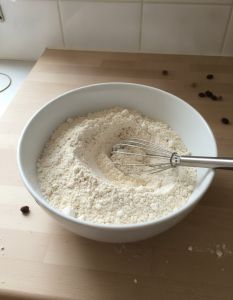
- Mix the dry ingredients: Whisk the rice flour, sorghum flour, tapioca starch and potato starch thoroughly with the xanthan gum (5.4 g), the dried yeast, caster sugar, salt, cardamom and nutmeg.
- Mix the dough: Add the gel, the milk, the lemon zest and the soaking liquid you kept. Mix with a sturdy spoon or the paddle of a stand mixer until evenly combined. Add the softened butter in several portions, mixing until it is incorporated, then beat for about 5 minutes. The dough is a soft, cohesive paste that holds a mound.

- Add the fruit: Work in the soaked raisins, the candied peel and the chopped almonds, at low speed or by hand. Scrape the bowl so the fruit is spread evenly. Rest the dough for 10 minutes to finish hydrating.

- Shape the fold: Line a baking tray with baking paper. Lightly oil another sheet of baking paper and your hands. Pat the dough into an oval of about 26 × 20 cm. If you use marzipan, roll it into a log slightly shorter than the oval and lay it just off centre. Using the paper to help, fold one long side over the other, leaving the lower edge projecting by about 2 cm. Press the seam gently and tuck in any exposed raisins.

- Let it rise: Transfer the loaf to the tray and cover loosely, without pressing on the dough. Leave it in a comfortably warm spot for about 90 minutes. It should look noticeably puffier, with softened contours; do not wait for it to double. If it has barely moved, allow more time.

- Heat the oven: Towards the end of the rise, preheat to 180 °C (160 °C fan) / 350 °F.
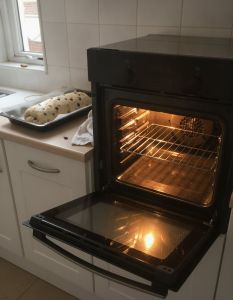
- Bake: Bake on the lower-middle shelf for 55 to 65 minutes. Tent loosely with foil once the top has coloured, usually after 30 to 35 minutes. The loaf should feel set through the centre; a probe inserted into dough rather than fruit or marzipan should read 96 to 98 °C.
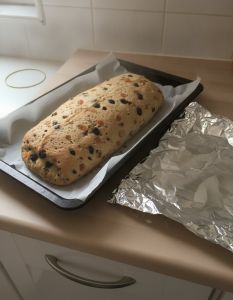
- Coat and cool: Melt the coating butter. Let the baked loaf stand on its tray for 10 minutes, then brush the top and sides with butter in several passes. Sprinkle with the coating caster sugar. Move it carefully to a rack and cool completely, about 4 hours. Sift the icing sugar generously over the cooled loaf.

- Wrap and rest: Wrap the fully cooled loaf and keep it in a cool place away from light and heat before you slice it: the flavour of a fruit Stollen develops as it rests. For longer keeping, freeze the fully cooled, wrapped loaf.

Notes
Coeliac notes
• Flours and starches: rice, sorghum, tapioca and potato are naturally gluten-free, but they can be milled where wheat is milled. Buy each one labelled gluten-free (milling cross-contact).
• Binders: buy the psyllium (husk or powder) and the xanthan gum labelled gluten-free. 12 g of husk is 4% and 5.4 g of xanthan is 1.8% of the 300 g of flours and starches. Do not add extra flour just because the dough feels softer than wheat dough: the gel, the rest and gentle shaping do the work.
• Check every ingredient separately: the binders, yeast, raisins, candied peel, spices, marzipan and icing sugar. A recipe or product category described as gluten-free does not replace those checks.
• Your kitchen: use clean equipment, baking paper and a work surface free of wheat-flour dust and crumbs. Check shared butter and sugar containers for cross-contact.
• Allergens: contains milk and almonds. The optional marzipan also contains almonds: check its full ingredient list. Baking tips
• Keep both peels if you can: orange brings sweetness, citron gives the familiar Stollen character.
• The unfilled loaf weighs about 1.2 kg after baking and coating; the optional marzipan adds a little more.
• Serve in thin slices at room temperature. Cut through the middle and press the two halves back together to protect the cut surfaces.